What makes Masaccio's Trinity worth stopping for?
Santa Maria Novella sits on the piazza of the same name, two minutes on foot from the train station, so most visitors walk past it dragging a suitcase without knowing what is inside. Masaccio's Trinity, painted around 1427 on the left wall of the nave, is the first painting in Western art to use true linear perspective, and it opens a flat wall into a chapel that isn't there. This guide covers the entry ticket, what the church actually holds beyond the facade, and how to fit a visit into an arrival or departure day.
About This Experience
Piazza di Santa Maria Novella 18, 50123 Florence
Two minutes on foot from Santa Maria Novella station, which makes it an easy arrival or departure day stop
Open daily; hours shift seasonally and around services, so confirm before you go
Entry with audioguide runs $18; the door price on its own is around €7.50
The Dominican church by the station that most visitors walk past dragging a suitcase
Masaccio's Trinity, the Tornabuoni Chapel frescoes, the Green Cloister and the Spanish Chapel
Check Live Availability & Prices
Slots move fastest around midday when arriving and departing trains both empty into the piazza, so booking a time ahead saves standing in the sun.
Which Santa Maria Novella Ticket to Pick
There is one product here: an $18 entry ticket that includes an audioguide. No separate guided-tour version exists, and for this church the audioguide matters more than usual. The Trinity is a wall fresco with no wall text next to it, and its significance, the first true linear perspective in Western painting, is not something the eye picks up on its own.
It suits anyone with an arrival or departure day to fill, since the church sits two minutes from the station and a full visit takes about an hour. It also suits anyone who cares more about art history than about ticking off the biggest names in the city; the crowds here are a fraction of what queues outside the Uffizi or the Accademia.
It does not cover a live guide, and it does not cover the facade close up, which most visitors photograph from the piazza and never look past. Pair a Santa Maria Novella visit with a look at what else the museums in Florence have on offer, since the church works best as one stop on a longer day rather than a destination on its own.
Your Santa Maria Novella Ticket
One ticket covers the church, the cloisters and the chapels, with an audioguide included.
from $18 Santa Maria Novella Entry Ticket & Audioguide
The church by the station holds Masaccio's Trinity, the first painting to use true linear perspective, plus the frescoed Green Cloister and the Spanish Chapel. Most visitors walk…
- Masaccio's Trinity
- Green Cloister frescoes
- Overlooked by most
What You'll See
The crowd photographs the marble facade outside, which Leon Battista Alberti completed by solving the awkward join between the wide lower church and the narrower upper nave with scroll volutes that architects have been copying since. Inside, most people walk straight past the Trinity on the left wall on their way to the altar. Giotto's crucifix hangs in the nave, easy to miss if you are looking for a painting rather than a carved figure.
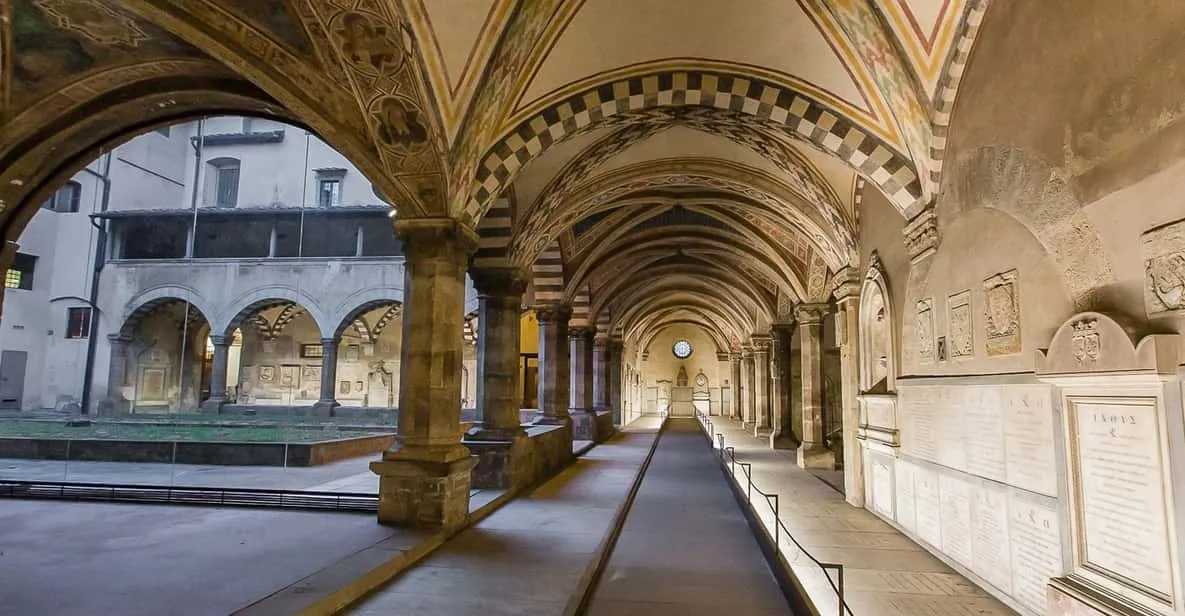
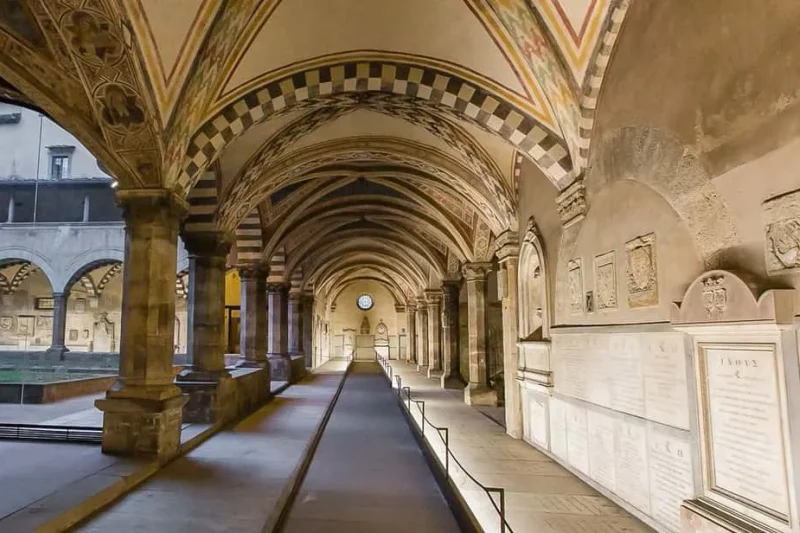
Behind the high altar, Domenico Ghirlandaio frescoed the Tornabuoni Chapel with scenes from the lives of the Virgin and John the Baptist; a teenage Michelangelo was working in his studio at the time. The Green Cloister takes its name from the green earth pigment Paolo Uccello used for his frescoes there, and the Spanish Chapel next to it is covered floor to ceiling in fourteenth-century fresco, one of the more complete cycles left in the city.
How a Visit Flows
-
On arrival
In from the station
The entrance sits off the piazza, a two-minute walk from the platforms, so this works dropped straight into an arrival or departure day.
-
First 10 minutes
The nave and Giotto's crucifix
Start in the nave rather than heading straight for the altar; Giotto's painted crucifix hangs overhead and gets skipped by visitors moving too fast.
-
10 to 20 minutes
Masaccio's Trinity
On the left wall, the fresco that started true linear perspective in painting. Let the audioguide run here; the illusion of a carved chapel in a flat wall is the whole point.
-
20 to 35 minutes
The Tornabuoni Chapel
Behind the high altar, Ghirlandaio's frescoes fill the walls, painted with a teenage Michelangelo working in the same studio.
-
35 to 50 minutes
Green Cloister and Spanish Chapel
Uccello's green earth frescoes in the cloister, then floor-to-ceiling fourteenth-century fresco next door in the Spanish Chapel.
-
Before leaving
The facade from the piazza
Step back outside and look up at Alberti's scroll volutes, the detail everyone photographs without knowing what solved it.
Know Before You Go
Not suitable for
- Visitors with only a few minutes between trains and no interest in art history
- Anyone expecting a live guide; this is an audioguide-only ticket
- Travelers who prefer their sightseeing air-conditioned in August; the nave is not
What to bring
- A layer to cover shoulders and knees; it is a working church
- Headphones if you prefer your own over a shared unit
- A photo ID in case of a bag check at busy periods
- Comfortable shoes for the walk over from the station
Not allowed
- Flash photography near the frescoes
- Bare shoulders or shorts above the knee
- Loud conversation during services, which can close sections without notice
Insider Tips
Most of what makes this church worth the detour takes patience rather than planning.
- Go early or late in the day; the piazza fills with luggage-dragging crowds moving between trains at midday
- Stand back from the Trinity before stepping close; the perspective trick only reads from a few paces away
- Check for services before you go, since parts of the church close to visitors during them
- The Spanish Chapel gets skipped by people rushing for the exit; give it the same time as the Trinity
- Bring the audioguide up before you reach the fresco, not after; the explanation matters more than the walk over
- Combine the visit with the station itself if you have a train to catch either side
Where You're Headed
Santa Maria Novella Tickets FAQ
How much are Santa Maria Novella tickets?
An entry ticket with audioguide costs $18. Buying at the door on its own runs around €7.50, without the audioguide.
What are the opening hours for Santa Maria Novella?
The church is open daily, but hours shift seasonally and around services, so confirm the current schedule before you go.
Does Santa Maria Novella close for services?
Yes. Parts of the church can close to visitors during services without much notice, which is worth building slack into your schedule for.
How do I get to Santa Maria Novella?
It sits two minutes on foot from Santa Maria Novella train station, which makes it an easy stop on an arrival or departure day.
What do you actually see inside Santa Maria Novella?
Masaccio's Trinity, Ghirlandaio's frescoes in the Tornabuoni Chapel, Giotto's painted crucifix, the Green Cloister and the Spanish Chapel.
Do I need to book Santa Maria Novella tickets ahead?
It is not usually as tight as the Uffizi or the Accademia, but booking ahead guarantees your slot and skips the door line during busy midday hours.
How long does a visit to Santa Maria Novella take?
About an hour covers the nave, the Trinity, the Tornabuoni Chapel and both cloisters at an unhurried pace.
Is there a dress code for Santa Maria Novella?
Yes. It is a working church, so shoulders and knees need to be covered to enter.
What Visitors Say
We had twenty minutes before our train and almost skipped it. The Trinity alone was worth turning back for; the audioguide explained why it mattered in a way I never would have gotten from just looking at it.
Far quieter than the Uffizi that morning, and the Spanish Chapel surprised me more than anything else we saw in Florence that week.
Good value at $18 with the audioguide included. The church itself is plain from the outside compared to the Duomo, so go in expecting the frescoes to be the reason, not the building.